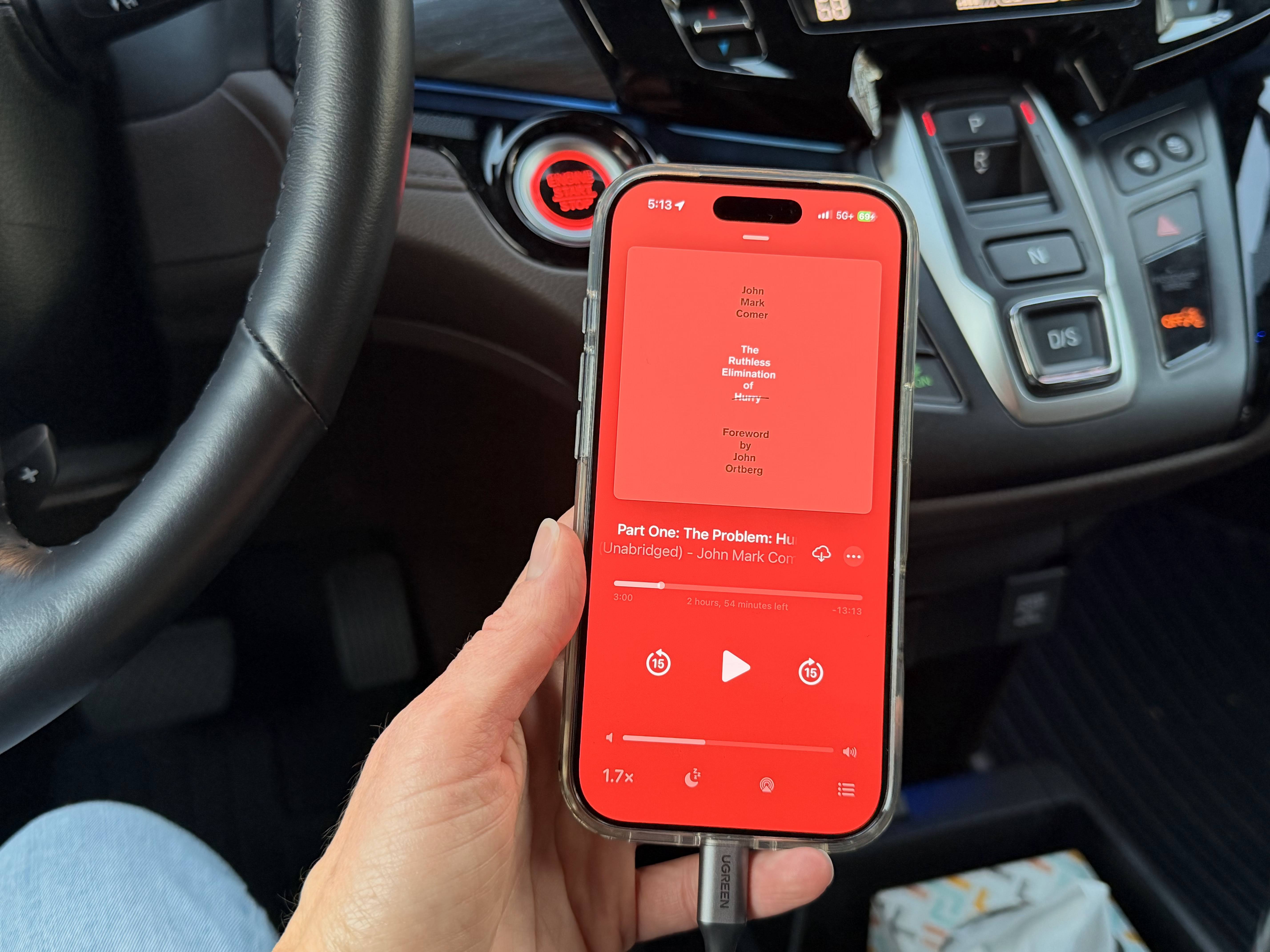
How ironic that I listened to The Ruthless Elimination of Hurry on audio because I didn’t have time to read it in physical form. This book by John Mark Comer not only serves as a cultural critique of our obsession with hurry but also offers the antidote. The subtitle suggests it: How to Stay Emotionally Healthy and Spiritually Alive in the Chaos of the Modern World.
Though I was intrigued by the book and what others were saying about it, I couldn’t fathom taking on one more thing. Thus, I listened as author John Mark Comer advocated against devaluing one of our most precious human resources: our time. I listened while driving to and from kids’ practices and sporting events. I listened while probably speeding and trying to do a third thing at the same time.
What stood out
Comer’s commentary and historical analysis of how our understanding of time has changed across generations was fascinating to me. Comer spends time lamenting our fast-paced lifestyles and what this record-speed way of life is doing to our souls. He gives us a sociology lesson on the history of technological advancements and their impact on our culture, family life, work life, and our understanding of rest.
Our hurriedness has indeed influenced every part of how we live our lives.
Hurry makes us angry and anxious and blinds us from our true dreams.
Comer bravely shows us the way to resistance, advocating for a slower, more intentional life. Inspired by his own struggle with hurry, he shows us a life that’s rare but possible: where technology enhances but doesn’t rule our lives. If you want the same, you ought to purchase a copy—a good ‘ol hardback-covered one.
In particular, in a chapter called “Slowing,” Comer discusses how to turn a smartphone into a dumb phone. He lays out steps for avoiding the worst of what smartphones and their digital distractions do to us. Moreover, he shows us how intentionally slowing down—like waiting in a checkout line—can help us become better people.
What it’s doing for me
My family used to own a lake place. We went nearly every weekend in the summer months for as long as I can remember. It was our way to engage in family time and recreation each week. You know—the whole “work hard, play hard” mentality.
But when our extended family sold the place, I realized I had been going hard all along. Recreation, while adding value and health to my week, is not the same as taking a Sabbath. Now that my weekends weren’t full of built-in boating adventures, weekly packing, and 2.5-hour drives each way, I had to learn how to sabbath well, possibly for the first time, halfway through my thirties.
It’s taken me years. The Ruthless Elimination of Hurry helped me learn the heart behind discovering new rhythms. It’s not just about what you put (or don’t put) on your calendar, but about your entire approach to life.
As a spiritual mentor of mine says, “Focused attention toward the work of Christ is how your life becomes less busy but more purposeful.”
I’m now in what feels like the busiest season of my life as a parttime working mom with three children in various extracurriculars. It often has me wondering how I’m going to keep up. I have to intentionally choose to come back to the heart of intentional rhythms—rhythms that make life more full, but not necessarily the calendar.
Comer’s credentials
Comer starts out highly relatable. This guy gets hurry. He’s made himself sick on hurry. And he realizes he has this problem with striving and hurry, all while pastoring a church.
Yet, his view of life and how he chooses to live it finally changes when he “reset the metric for success.” Hating the vision of who he was becoming, Comer bravely chooses to reject the world’s version of success, even veiled in godly living and what the world says it takes to lead a growing church. He decides to slow down, pare down, choose smaller.
Now Comer has written over a dozen books, several of which are bestsellers. He’s currently best known for authoring Practicing the Way; content from this book has extended beyond the pages and into full-time ministry, where Comer trains Christians to return to ancient ways of following Jesus. The book, as well as The Ruthless Elimination of Hurry are full of best practices for “human-ing,” as some call it.
Benefits of reading the Ruthless Elimination of Hurry
Technology offers us many advantages, but it also threatens to steal the best of what makes us human. While it makes certain aspects of life easier, it also quickens our collective pace to the point of exhaustion. We now know what we can accomplish with a phone in our hand or a computer on our desk. We can’t imagine going back to a slower time or accomplishing anything less, even if it takes so much from us.
Comer even compares hurry to an addiction—in his quest for a new way forward, he has to detox from the old way. Also, he sometimes “slips back into hurry.”
I feel this too. So many of us have been doing life this way for so long, it takes time to learn a new way. As John Ortberg says in the foreword, “It is scary. It is an act of faith. But there are deeper riches on the other side.”
In The Ruthless Elimination of Hurry, Comer is the soul cry of a generation weary of our constant state of urgency but unsure if we’re willing to go back to a slower pace of life. I’ll join Comer in daring you to the bravery of slowing down. You may find you like the view here.
See Self Ctrl’s other book reviews HERE.

Written by: Jenna Kruse
As a speaker, writer, and mom of three, Jenna Kruse helps parents with school-aged kids overcome the frustration, fatigue, and hopelessness of parenting in the digital age so they can enjoy their kids and thrive in their role of raising the next generation to know and love Jesus. Alongside her husband, Jenna has worked with teens for over twenty years in the public school setting, the non-profit sector, and the church.