My middle daughter was diagnosed with and treated for sleep apnea when she was just three years old. As I lay with her during her recovery, I found myself welling up with tears watching her sleep. I was amazed at the ease with which she moved about life, particularly in the mornings. Her meltdowns had all but disappeared. She gained healthy weight. She entered preschool thriving, full of energy, and with cognitive capacity to learn. She was a new person. This transformation made me realize something important:
Sleep is a big deal. It feels intrinsic to our lives, so often we don’t spend much time thinking about it. We aim for certain bedtimes, take note when our kids are overtired, and do our best to help them get the sleep they need.
Science tells us, though, that sleep is one of the most crucial factors in our overall wellness. Studies1 show strong associations between lack of sleep and…
Sleep quality impacts kids’ bodies on almost every level.
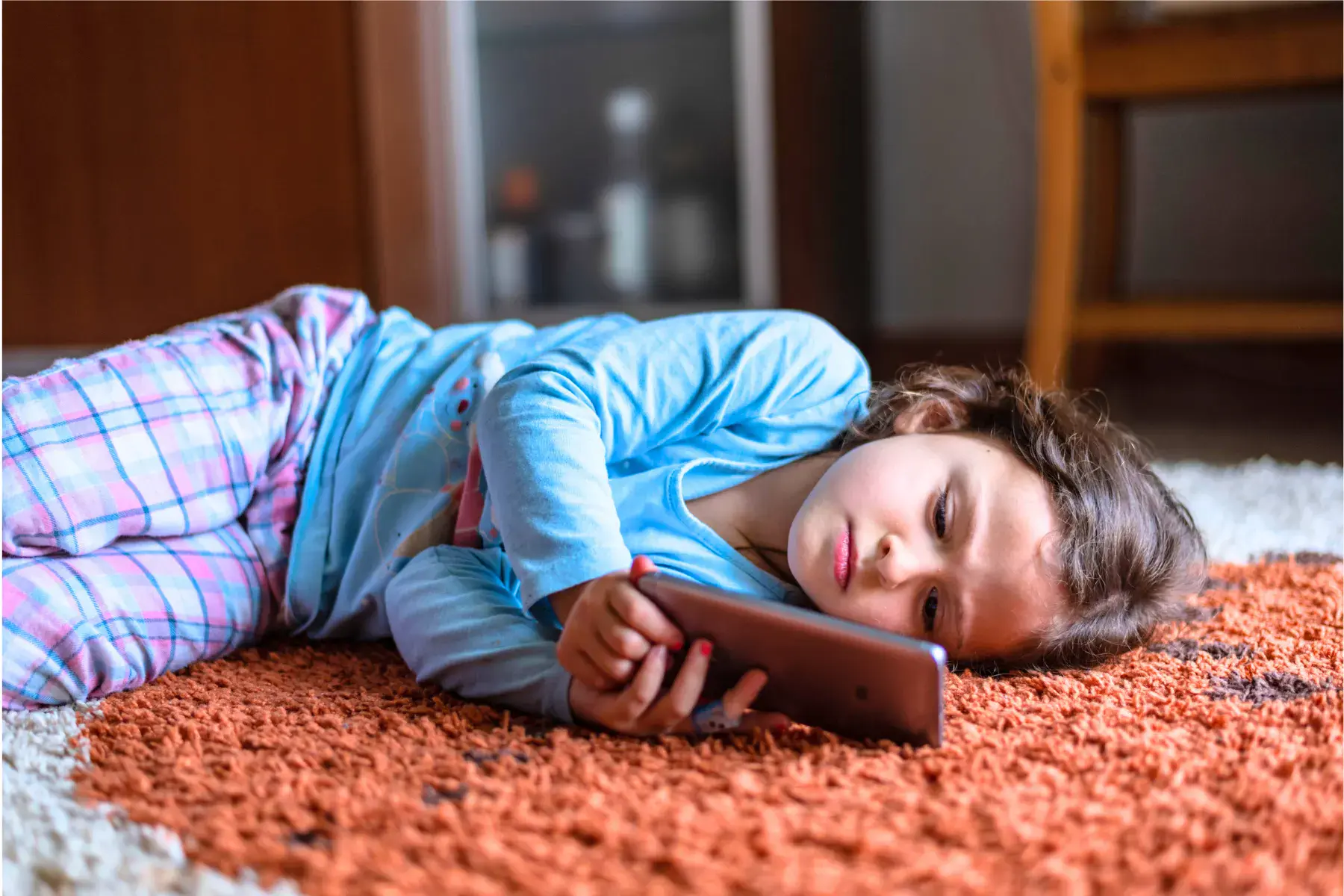
If you’re feeling concerned about whether your child is getting enough sleep, it may be worth looking at their screen time habits. Shifting screen use may actually be an easy key to unlock better and more restorative sleep for kids, and parents, too.
How Do Screens Interrupt Sleep?
We all possess an internal clock called our circadian rhythm. As the Cleveland Clinic explains, this rhythm is a set of instructions that our brain releases throughout the day to keep us on a 24-hour schedule. This schedule dictates when we sleep and wake. It also has influence over other systems like hormone releases and body temperature.
Screens confuse the natural rhythms of our bodies in a number of ways. In a recent review of literature, “90% of included studies found an association between screen media use and delayed bedtime and/or decreased total sleep time.”
The 4 Most Likely Causes:
Let’s think about how those things play out in day-to-day habits at home…
Blue Light
There is varying evidence on whether blue light directly affects sleep. Some literature suggests that blue light suppresses the release of melatonin. Sunlight in the mornings naturally cues the brain to stop releasing melatonin to help us wake up. Blue light is believed to have similar effects.
While the effect of blue light directly on sleep is still being studied, it is certainly one of many aspects of screen use that can disrupt the bodily functions that prepare us to sleep.
Cognitive Stimulation
Imagine sitting down to your computer to solve a work problem, as the last thing you do before you get in bed for the night. Your thinking is flooded with numbers, ideas, or strategies. You engage in complex problem-solving or rapidly write emails. Your brain is reactivated. How many of us, as adults, can then simply jump in bed and fall asleep? Maybe you still get in bed, but you read a book, scroll social media, or watch TV first. Whatever you choose, you likely need a few minutes to get drowsy.
The same thing happens to our kids when they are playing a video game, “iPad” game, or even doing homework on their laptop right before bed. Children may want to play video games to wind down. In reality, the screen time is actually stimulating their brains with problem-solving demands, loud noises, bright colors, and fast-paced imagery. Going from video games directly to a quiet bedtime routine is counterintuitive to their internal processes. For many kids, bedtime ends up being difficult. It gets delayed because they struggle to wind down and feel sleepy, and precious minutes or hours of sleep are lost for the night.
Emotional Stimulation
Next, imagine you are lying in bed and start scrolling social media to relax. As you scroll, you catch a political meme that a good friend posted. To you, it feels highly offensive and inappropriate. You start feeling angry that she put it up. You wonder how she could have considered something like that funny? Does my friend really think this way? Do I even want them to be my friend?
So much of what we see on our screens is emotionally charged, especially for kids with access to social media. When we see or read something that our brains perceive as a “threat” (aka something we disagree with, feel passionate about, etc), our body responds by releasing stress hormones, including cortisol.
Understanding Cortisol
Dr. Kristyn Gregory explains that cortisol is designed to help protect us by releasing sugar into the bloodstream. This helps our brains function under stress. She also says it plays a key role in helping the body go to sleep and wake up as part of its circadian rhythm. Cortisol levels naturally drop at night, and rise in the morning, to prepare our bodies to wake up.
When our kids view emotionally charged content on their screens before bed, they are experiencing cortisol releases that are meant to help our brains be more alert. Maybe kids wake up more in the middle of the night, feel more restless, or lack the deep sleep their bodies require to recharge. Bottom line is, screens can cause our bodies to work in ways that prevent sleep, rather than encourage it.
Choosing Screens Over Sleep
We all have days or moments when we make the haunting choice to stay awake too late watching a movie or show we love. It happens. However, it can become problematic if your child is consistently struggling to separate from media in order to get ready for bed. It can also indicate increased dependency on screens if your child is regularly and willingly sacrificing sleep in order to continue playing/watching. If you think your child may be having abnormal difficulties separating from screens, it may help to learn more about how dopamine creates screen addictions, and how to identify when it has become a problem. You can also visit the SelfCtrl resource page to get support.
Healthy Screen Use Habits to Improve Sleep
A recent study found that 3/4 of American children and adolescents report keeping at least one screen-media device in their bedroom, while roughly 60% report regular use of these devices during the hour before bedtime.
We are a society that depends on screens during the day, but limiting them at night can lead to drastically improved sleep for many. For better rest, here are a few simple and effective changes we can make to screen time.
Creating change or establishing new habits in any area of our lives always feels daunting. Change is possible though, especially when we take small, achievable steps. Start by adjusting one small habit. You will reap benefits in sleep and overall wellness in ways that naturally motivate everyone to continue to make changes in the right direction.
For more ideas, check out Common Sense Media. The American Academy of Pediatrics also offers helpful information.

Authored by: Courtney G. DiStefano, CCLS
Courtney G. DiStefano is a Certified Child Life Specialist, child development expert, and mom of three with nearly fifteen years of clinical experience serving children and families in hospitals and social-service settings.
- Hale, Kirschen, LeBourgeois, Gradisar, Garrison, Montgomery-Downs, Kirschen, McHale, Chang, & Buxton, 2018, p.1. ↩︎
General References
Hale, L., Kirschen, G. W., LeBourgeois, M. K., Gradisar, M., Garrison, M. M., Montgomery-Downs, H., Kirschen, H., McHale, S. M., Chang, A. M., & Buxton, O. M. (2018). Youth Screen Media Habits and Sleep: Sleep-Friendly Screen Behavior Recommendations for Clinicians, Educators, and Parents. Child and adolescent psychiatric clinics of North America, 27(2), 229–245. https://doi.org/10.1016/j.chc.2017.11.014
Alshoaibi, Y., Bafil, W., & Rahim, M. (2023). The effect of screen use on sleep quality among adolescents in Riyadh, Saudi Arabia. Journal of family medicine and primary care, 12(7), 1379–1388. https://doi.org/10.4103/jfmpc.jfmpc_159_23